

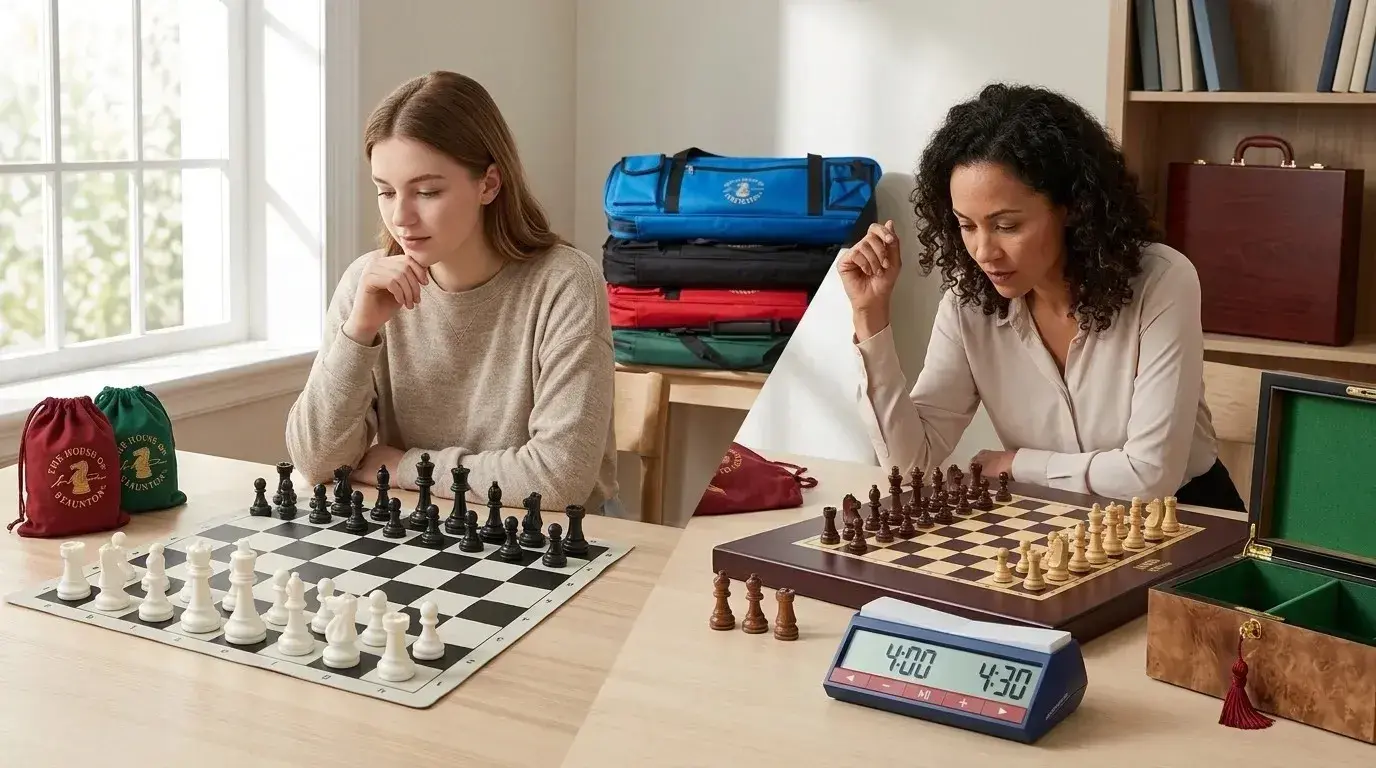
Chess has seen a genuine resurgence in the US over the past several years, and that boom has flooded the market with sets ranging from $12 plastic starter kits to hand-carved collector pieces costing thousands. The right choice depends entirely on one question most buying guides skip past too quickly: are you learning the game, or are you playing it seriously? The best chess sets for beginners look surprisingly similar to what serious tournament players use, and understanding why will save you from both overspending and under-buying.
This guide breaks down what actually separates a genuinely useful chess set from an attractive but impractical one, covering Staunton design standards, sizing, weighting, and specific recommendations for each type of player. You can also check our own US Chess Sales promo codes for verified discounts on tournament and beginner sets, since even a modest chess budget benefits from good timing.
Why the Staunton Design Is the Answer for Almost Everyone
Before splitting recommendations by skill level, it's worth understanding why nearly every serious guide points toward the same design family. The Staunton pattern was created in 1849, endorsed by chess celebrity and journalist Howard Staunton through the Illustrated London News, and has never been meaningfully replaced as the standard for competitive play. Before Staunton, chess sets were often beautiful but genuinely confusing, ornate, artistic pieces that made it difficult to tell a bishop from a queen in a fast-moving game.
FIDE, the World Chess Federation, formally recommends the Staunton design for all competition, and the US Chess Federation follows the same standard at its own rated events. Each of the six piece types has a distinct, functional shape you can identify at a glance from across the board, which is precisely the point. That clarity benefits a first-time player just as much as a tournament veteran, which is why Staunton remains the default recommendation across skill levels rather than something beginners graduate into later.
What Actually Matters: Sizing and Weight Standards
Whether you're buying your first set or your fifth, a few measurable standards separate a genuinely usable set from one that will frustrate you during play.
King Height and Board Squares
Tournament standard calls for a king height around 3.75 to 4 inches, with board squares in the 2.0 to 2.25 inch range. FIDE's official equipment rules put competition squares in the 5 to 6 centimeter range, with a king around 9.5 centimeters and a base measuring roughly 40 to 50 percent of the piece's total height. This proportion isn't arbitrary. A properly sized set feels balanced and easy to read, while a poorly proportioned one creates subtle visual stress during play that most people can't quite articulate but definitely notice.
Weighted Pieces
Weighted pieces (typically achieved with a lead or metal insert in the base) provide meaningfully better stability and a more serious playing feel, especially during fast games or when pieces get moved quickly during capture sequences. Unweighted pieces are common in budget starter sets, and while this is a reasonable trade-off for a first purchase, serious players notice the difference immediately. A slight bump on an unweighted set can send pieces toppling mid-game.
Felted Bases
A small detail that matters more than it sounds: felt on the underside of each piece prevents scratching on the board and allows pieces to slide smoothly during play rather than catching or scraping. This is a reliable quality indicator across price points.
Best Chess Sets for Beginners
A genuinely good beginner set doesn't need to be expensive, but it does need to be readable, durable, and not intimidating. Clear piece shapes matter more than decorative flourishes, since a new player already has enough to focus on without also decoding an unusual piece design.
What to Look For
A standard Staunton silhouette. Learning to recognize piece shapes on a clear, standard design transfers directly to club play, tournaments, and even chess books and coverage, all of which assume Staunton pieces.
Enough weight to feel planted. A beginner set doesn't need tournament-grade triple weighting, but pieces that tip over during ordinary play will frustrate a new player more than a design flaw ever would.
Coordinates on the board. Letter and number notation along the board's edge (like a1 or h6) is essential for recording games, following chess books, and building the habits that carry into more serious play later.
A complete, practical package. Extra queens for pawn promotion practice, a durable roll-up or foldable board, and a simple storage solution round out a genuinely useful starter set.
Practical Beginner Picks
Entry-level tournament-regulation sets with weighted or lightly weighted Staunton pieces and a vinyl roll-up board are widely available under $25, and multiple independent testers have found that quality at this price point punches well above what the cost suggests. Look specifically for a set that includes regulation king height (close to 3.75 inches) even at a budget price, since this is a detail some cheap novelty sets skip entirely. A complete package, pieces, board, and a simple bag or box, is worth prioritizing over buying pieces and a board separately as a first purchase.
Best Chess Sets for Serious Players
Once you're playing regularly, whether that's club nights, rated tournaments, or serious home study, the priorities shift meaningfully.
What to Look For
Heavier weighting. Triple or quadruple-weighted pieces resist accidental bumps during faster time controls and simply feel more substantial in the hand, which matters over the hundreds of games a serious player accumulates.
Precise tournament sizing. A 4-inch king paired with 2.25-inch board squares is the combination most closely matching official tournament proportions, and pairing mismatched piece and board sizes is a common mistake when buyers purchase components separately.
A stable, quality board. Serious players often underestimate how much the board itself affects the experience. A board with correct square sizing, clean color contrast, and a surface that doesn't cause pieces to slide unintentionally makes a real difference over long games or analysis sessions.
Material choice based on actual use. Plastic Staunton sets remain the practical standard for regular club and tournament play, durable, easy to clean, and able to handle thousands of games without meaningful wear. Wooden sets are the traditional choice for home play and serious collecting, offering a tactile experience many players describe as what makes the game "feel real," but they typically cost more and require more careful handling.
Practical Serious-Player Picks
Mid-range wooden Staunton sets in the $50 to $150 range offer the best balance of craftsmanship and value for a serious home player, often using the same piece pattern seen at major tournaments and championships. For club and tournament use specifically, a heavily weighted plastic Staunton set paired with a proper vinyl or silicone tournament board remains the practical standard, durability under regular use matters more here than material prestige. Players moving into blitz or fast time controls should prioritize stability and clarity above all else, since confusing piece shapes and lightweight pieces that tip easily are punished hardest in fast games.
Wooden vs. Plastic: An Honest Comparison
This is one of the most common questions buyers ask, and the honest answer depends entirely on how you'll use the set.
Plastic sets are durable, affordable, easy to clean, and ideal for schools, clubs, travel, and regular tournament play. Quality plastic sets are still weighted and felted and meet the same FIDE tournament specifications as wooden equivalents. They are the standard at US Chess Federation events and most clubs, not because wood is inferior, but because plastic handles the wear of frequent, high-volume use better.
Wooden sets create a genuinely different tactile and emotional experience. Real wood introduces warmth, natural grain variation, and a weight-in-hand feel that synthetic materials don't replicate. This is why wooden Staunton sets continue to dominate among serious hobbyists, collectors, and home players seeking long-term satisfaction, even though they aren't inherently more "correct" for competitive play than a quality plastic equivalent.
The practical takeaway: choose plastic if durability, portability, and cost matter most; choose wood if the tactile experience and long-term home enjoyment matter more than raw practicality. Neither choice is a downgrade, they simply serve different priorities.
A Simple Framework for Choosing
Match your purchase to your actual routine rather than an aspirational one:
First serious set, want to learn properly: A weighted plastic Staunton set with a roll-up vinyl board, under $25, with correct king height and board coordinates.
Regular club or tournament play: A heavily weighted plastic Staunton set with a proper tournament-standard board, prioritizing durability over material prestige.
Home use and long-term enjoyment: A mid-range wooden Staunton set, $50 to $150, offering real craftsmanship without collector-level pricing.
Travel or space-constrained play: A smaller set around 3 inches in king height, or a magnetic folding set for genuine portability, understanding that very small sets can feel cramped for serious study.
Collecting or display: Premium hand-carved sets above $150, where materials like ebony, boxwood, or walnut and hand-finished detail justify the investment as much for aesthetics as for play.
Common Mistakes to Avoid
Buying a themed or novelty set as a first serious set. These can be genuinely fun for casual games with friends or family, but confusing piece shapes make learning and club play meaningfully harder. Save novelty sets for casual, non-competitive play.
Mismatching pieces and boards bought separately. If you're building a setup piece by piece, confirm your king height and board square size are proportionate. A king that's too tall or short for its board square looks and plays awkwardly.
Assuming expensive automatically means better for your use case. A $40 tournament-standard plastic set will serve a club player better than a $300 display set that wasn't built with frequent handling in mind.
Ignoring board quality when upgrading pieces. Many players focus entirely on pieces and forget that a smooth, correctly sized, well-contrasted board affects the actual experience of play just as much.
The Bottom Line
The best chess set for a beginner and the best chess set for a serious player share more in common than most buying guides suggest: both benefit from the Staunton design, correct tournament proportions, and pieces stable enough to survive real play. The differences show up mainly in weighting, material, and how much you're willing to spend on the tactile experience once you know you'll be playing regularly. Start practical, and upgrade toward wood, heavier weighting, or collector-quality craftsmanship once you know chess is a habit rather than a phase.
For the latest verified offers, bookmark our US Chess Sales coupons code, where we track current discounts on tournament sets, wooden boards, and beginner packages so you can build your setup without paying full price on every piece.